At the request of ACDN (Action des Citoyens pour le Désarmement Nucléaire), the IFOP Institute (Institut Français d’Opinion Publique) has conducted a poll on how much French citizens support the notion of extending France’s "nuclear deterrence" to France’s European allies.
The polling was done on a sample of 1000 persons representing the French population aged 18 and above.
The sample’s representativity was ensured by the quota method (the person’s sex, age, occupation) after stratification by region and town category.
The interviews were done on a self-administered online questionnaire on 12-13 March 2025.
Intro :
France’s "nuclear deterrence" consists of threatening to use nuclear weapons, as a "final warning" against any country that would threaten France’s "vital interests."
The President of the Republic stated in his speech of 5 March 2025 that he had "decided to open the strategic debate about whether to use (nuclear) deterrence for the protection of allies on the European continent."
Question: Are you in agreement with this proposal from the President of the Republic?
***
Results of the Poll
According to this poll, it seems that French citizens are very divided. Four out of ten (40 %) agree with President Macron’s proposal - 11% strongly agree, 29% somewhat in agreement). Nearly four out of ten are not in agreement (38%, of whom 16% somewhat disagree and 22% strongly disagree). A little over two out of ten (22%) do not state a view..
There are twice as many women as men not stating a view (29 % against 15%). Those women who do are shared almost equally between those who agree (35 %) and those who disagree (36%) with the President’s proposal - but those who totally agree are only 7%, whereas 19 % totally disagree.
Among the 85% of men stating an opinion, 45% are favourable (including only 15% strongly in agreement) while among the 40 % opposing it, 26% are in strong disagreement.
Overall, the percentage of French citizens strongly opposed to the proposal (22%) is double those who are strongly favourable (11%).
Age is also a factor. In general terms, the older people are, the more clear-cut their views. Among those under 35, 33% do not state a view, whereas among those 35 and over only 18% do not state a view (and only 15% among those over 65). The favourable views come out on top in all age-groups except one, that of the 50-64 years group, where 39% agree (12% strongly) and 43% disagree (28% strongly). In all age-groups without exception one pheomenon is seen: the proportion "strongly agree" is exceeded by those "strongly disagree" - sometimes by a factor of three (in the 35-49 group, 7% agree strongly, 21% disagree strongly.)
In other words, those opposed to the President’s proposal, though slightly less numerous than its supporters (38 % over 40 %) seem much more determined in their oppositon than the supporters in their support.
Unsurprisingly, the political tendencies of those polled (as declared by themselves under guarantee of anonymity, along with their voting in the first round of the 2022 presidential election and first round of the 2024 parliamentary election) largely determines their choice between agreeing and disagreeing. Two main criteria seem at play: the positioning of the party with regard to Europe and their position towards the President of the Republic. Nevertheless, this second criteria seems relatively secondary, except among the Macronists.
Thus, 71% of those sympathising with the presidential majority support the proposal - including 85% for those sympathising with Renaissance. On the right wing, the Republican sympathisers are a strong majority in supporting it (59 % against 34 %).
On the other hand, the most determined opponents are found in the "radical right". Twice as many sympathisers of the Rassemblement National oppose the President’s proposal than support it (52 % against 26 %) and only 9 % support it strongly - whereas 31% are strongly opposed. Those who support Eric Zemmour (a group not strongly represented in the sample) answered thus: 3% strongly in favour, 33% rather in favour, 4% rather opposed amd 49% strongly opposed (the absolute record)
On the left, the majority of those who voted for the New Popular Front (NFP) in the parliamentary elections of July 2024 support the proposal (49 % over 29 %). But the question reveals a strong gap between the sympathisers of LFI (France unbowed) and those of the other parties of the NFP, socialists and ecologists (the communist voters were not clearly identifies). 35% of the LFI voters are favourable to the proposal (7% strongly) and 41% hostile (including 27% strongly disagreeing). Conversely, 61% of the Socialist voters agree with it, 27% disagree. Among them the strength of support (20 %) is much greater than the strength of opposition (6 %). The ecologist voters take a similar position (58% favourable, 28% hostile). Yet compared with the socialists their support is clearly less firm (11% strongly in favour, against 9% strongly opposed)
Among the people polled who did not state any partisan view, there were a third (33%) not pronouncing on the question; and those who did state a view are shared between 29% agreeing (6% strongly) and 38% disagreeing (including 24% strongly against, four times more). There also, as everywhere else except in the socialist sympathisers, we see that the opposition to the President’s proposal is much firmer that the support.
***
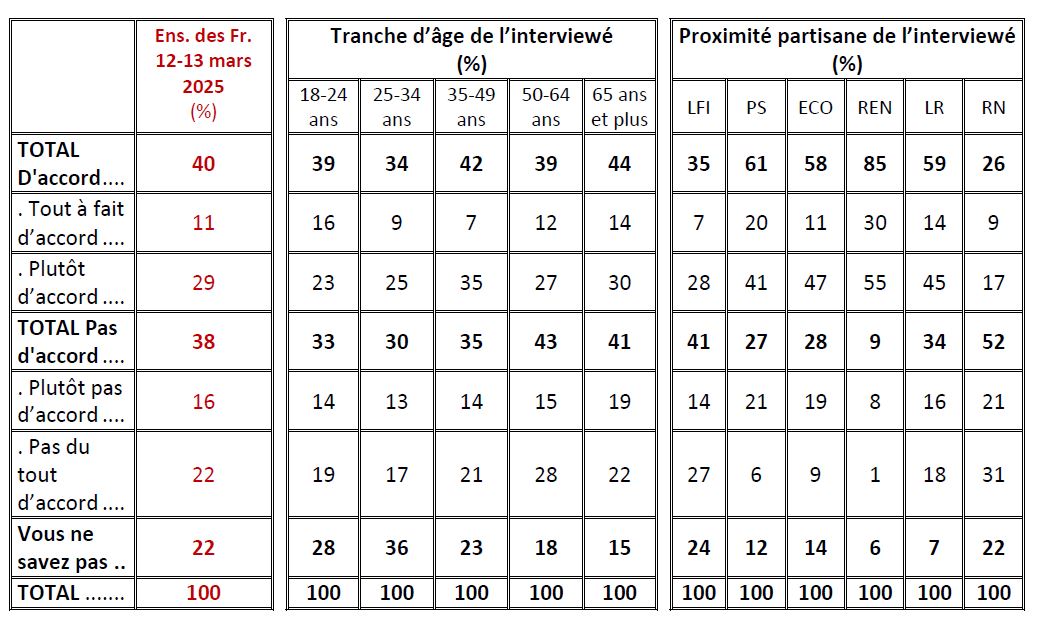
IFOP-ACDN. Table of the poll results. ©ACDN
From the poll as a whole it is evident : that the President’s proposal is far from having unanimous response, either for it or against, that nevertheless the opponents are everywhere more resolute than the supporters (except for the socialist sympathisers), that a good number of French men (15%) and above all French women (29%) seem to want more information before forming an opinion. This wait or expectation is particularly marked among those aged 18-24 (28%) and 25-34 (36%)
Therefore the question deserves to be seriously debated, and even possibly decided by referendum.
In addition, it is important to note that the question focussed on whether to extend France’s "nuclear deterrence" to European allies, and not on this deterrence itself, i.e. its effectiveness and legitimacy. Any future referendum about its extension to Europe should certainly not ignore that other debate, because the French people have never been consulted about the usefulness, for themselves, of France’s nuclear strike force - not before France’s first nuclear test Gerboise Bleue on 13 February 1960 or at any time since then.
Action des Citoyens pour le
Désarmement Nucléaire (ACDN)
31, Rue du Cormier – 17100 - SAINTES
Tel : +33 (0)6 73 50 76 61
contact@acdn.net www.acdn.net
***